

Blog
Insulated Hand Tools Rated to 1,000V: Buying Guide

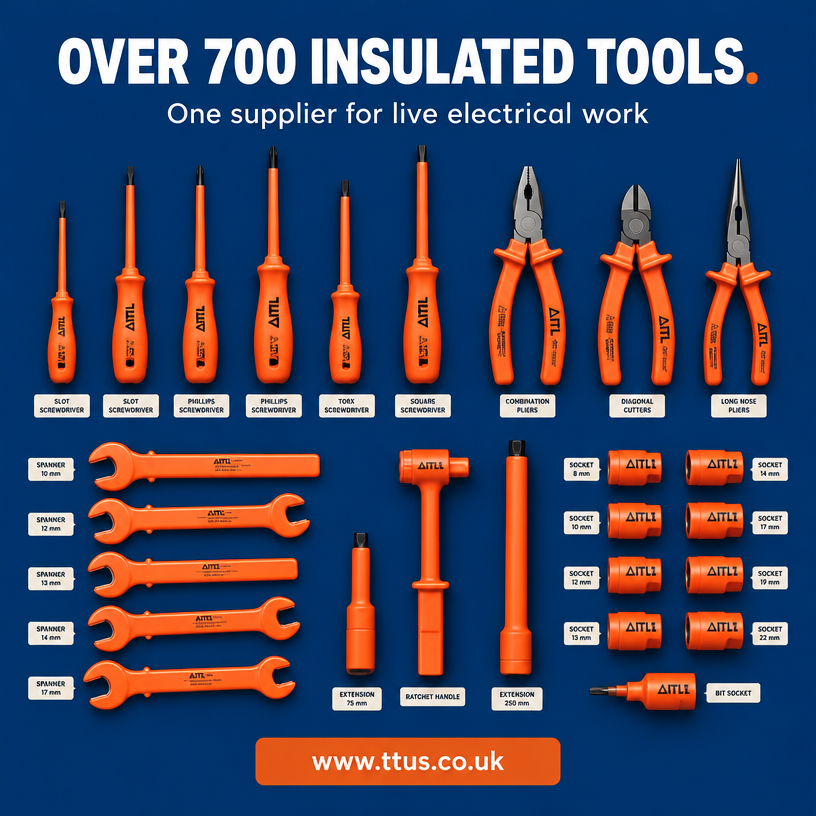
When you are working on or near live conductors, the difference between a safe job and a serious incident often comes down to one thing: whether the tools in your hands are genuinely rated for it. Insulated hand tools rated to 1,000V are the baseline for live electrical work in the UK, but not every product sold as ‘insulated’ meets the same standard. This guide walks you through how to specify, check and buy a set that will protect you on site.
What ‘1,000V Rated’ Actually Means
Insulated tools are designed so that the user is protected from electric shock when working on or near energised parts. A 1,000V rating refers to the maximum working voltage the tool is tested and approved for. It is a working limit, not a safety margin to be used creatively. Tools rated to 1,000V are typically dielectric-tested at far higher voltages during manufacture to confirm the insulation holds up under fault conditions.
The Two Standards That Matter
If you work in the UK, the key standard is IEC 60900 (harmonised as BS EN 60900). It sets out the requirements for insulated hand tools for live working up to 1,000V AC and 1,500V DC, covering insulation thickness, adhesion, impact resistance, flame retardancy and dielectric testing. Look for tools marked as Category C, which denotes the highest class of insulation performance.
In the US and on many international projects, ASTM F1505 is the equivalent benchmark. Tools that meet both IEC 60900 and ASTM F1505 are the safest bet for teams working across borders, because the certification is recognised on both sides of the Atlantic.
Crucially, every tool should be individually tested before it leaves the factory, not batch tested. Injection-moulded insulation that is bonded directly to the steel, rather than dipped, is a strong sign that a manufacturer takes that testing seriously.
How to Choose the Right Insulated Tool Set
1. Match the tools to the work you actually do
Start with the jobs on your schedule. Linesmen and cable jointers need insulated pliers, cable cutters, adjustable wrenches and screwdrivers, while overhead line teams lean on insulated socket sets and torque tools. Buy for the tasks you perform weekly rather than a generic kit that leaves you short on the one tool you need most.
2. Check the rating, test voltage and category
Confirm the working voltage marked on the tool itself. A 1,000V tool is the UK standard for live work, but some tasks call for 1,500V DC capability. Check the Category marking and the test voltage, and make sure the tools carry a visible manufacturer mark rather than an unbranded sticker.
3. Insist on injection-moulded insulation
Dipped insulation can flake, crack or peel away from the metal, leaving an uninsulated edge you may not spot until it matters. Injection-moulded insulation is moulded directly onto the tool body, giving a stronger bond and more consistent thickness. A quality range will be manufactured this way across the full range, with a lifetime warranty on both the tool and the insulation as a sign of confidence.
4. Plan for ageing, inspection and retest
Insulation does not last forever. UV exposure, chemicals, heat and physical knocks all degrade the protective layer over time. Build tool inspection into your routine, follow the manufacturer’s retest interval, and replace anything with cuts, gouges or exposed metal. Keep a record so you can prove compliance during an audit or site inspection.
5. Buy where availability and replacement are reliable
On a live job you cannot wait a fortnight for a replacement. Choose a supplier that stocks the full range, offers fast shipping and sells individual tools as well as sets, so you can replace one damaged item instead of buying a whole kit.
Common Mistakes When Buying Insulated Tools
- Assuming every ‘insulated’ tool is live-work rated. Insulated handles for comfort are not the same as tools certified to IEC 60900.
- Mixing categories. A 1,000V tool used on higher-voltage work offers no protection.
- Skipping inspection. A single unnoticed cut in the insulation defeats the whole point.
- Buying the cheapest unbranded set. Certification, individual testing and a warranty are what you are paying for.
Where to Buy 1,000V Insulated Hand Tools in the UK
TallTree Utility Suppliers stocks a comprehensive range of insulated hand tools rated to 1,000V, made in the UK and tested to IEC 60900 Category C and ASTM F1505. The range covers insulated screwdrivers, pliers, cable cutters, socket sets and more, with a lifetime warranty on tools and insulation. Browse the insulated hand tools range on ttus.co.uk and speak to the team if you need help specifying the right set for your crews.
Final Thoughts
Choosing insulated tools is not about buying the biggest set. It is about buying tools that are genuinely certified for the voltage you work on, moulded to last, and backed by a supplier who can get replacements to you fast. Match the tools to the job, check the standard, and inspect them regularly. Do that, and your insulated set becomes one of the cheapest pieces of insurance on site.

 Overhead Safety Equipment
 Carabiners and Scaffold Hooks
 Fall Arrests
 Harnesses
 Lanyards
 Overhead Kits
 Slings
 Lifting and Tensioning
 Cable Pullers
 Poling
 Live Line Working
 Face Shields
 Live Working Accessories
 Insulated Hand Tools
 Insulated Allen Keys
 Insulated Link Extractors
 Insulated Nut Spinners
 Insulated Pliers and Cutters
 Insulated Ratchets and Sockets
 Insulated Saws and Knives
 Insulated Screwdrivers
 Insulated Spanners
 Insulated Specialist Tools
 Insulated Tool Kits
 Insulated Wedges
 Hand Tools
 Hammers
 Tool Bag
 Torches

 Carabiners and Scaffold Hooks
 Gate Guards

 Insulated Digging Tools
 Pole and Post Shovels
 Core Drills
 Core Drill Accessories
 Reinstatement
 Diamond Saw Blades
 Abrasive Materials Diamond Blades
 Asphalt Diamond Blades
 Ceramic Diamond Blades
 Dual Purpose Diamond Blades
 Flush Cut Diamond Blades
 Hard Materials Diamond Blades
 Metal Cut Diamond Saw Blades

 Demarcation
 Lamps
 Ramps
 Safety Traffic Barriers
 Traffic Cones

 Riggers
 Safety Boots
 Safety Shoes
 Safety Trainers
 Socks
 Wellingtons

 Flame Retardant Workwear
 Flame Retardant Accessories
 Flame Retardant Coveralls
 Flame Retardant Hats and Snoods
 Flame Retardant Jackets and Fleeces
 Flame Retardant Jumpers and Hoodies
 Flame Retardant Polo and T-Shirts
 Flame Retardant Trousers
 Flame Retardant Under Garments
 Flame Retardant Waterproof Coveralls
 Flame Retardant Waterproof Jackets
 Flame Retardant Waterproof Trousers
 Workwear
 Base Layers and Thermals
 Body Warmers
 Fleeces
 Hats and Snoods
 Hoodies
 Jackets
 Jumpers
 Trousers
 Coveralls
 Waterproof Clothing
 Waterproof Jackets
 Waterproof Trousers
 Hi Vis Vests
 Holdalls & Kit Bags


 Eye Protection
 Gloves
 Head Protection
 Bump Caps
 Chin Straps
 Ear Defenders
 Hard Hats
 Helmet Accessories
 Sweat Bands
 Ear Defenders
 Face Masks
 First Aid
 Hand Wipes
 Spill Kits