

Blog
Demarcation Barriers: Choosing the Right Barrier for Civils

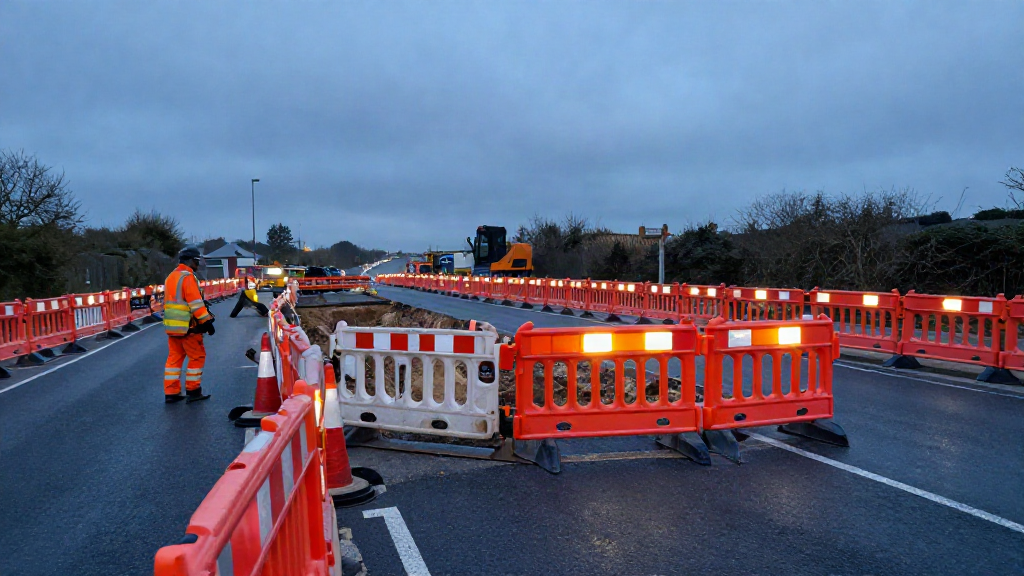
A demarcation barrier is one of the simplest pieces of site safety equipment you will ever buy, and one of the easiest to get wrong. When a work area sits next to a live highway, a footway or a public footpath, the barrier you choose decides whether pedestrians and traffic are kept clear of the hazard, and whether your setup stands up to a site inspection. This guide explains what a demarcation barrier actually does, how it differs from edge protection and guarding, and how to pick the right one for highway, footway and excavation work.
What is a demarcation barrier?
A demarcation barrier is a physical marker that defines the boundary of a work area. Its job is to separate the public, or other workers, from a hazard – an excavation, a live services pit, a section of resurfaced road, or an open trench. Demarcation barriers are not usually designed to take the full weight of a person falling; they signal where the safe area ends and the risk begins, and they keep people on the correct side of that line.
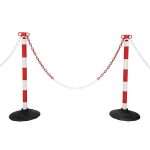
In practice, a demarcation barrier on a utility or civils site is often a temporary fence panel, a road barrier, a cone-and-bar system, or a mesh pedestrian barrier. What they share is visibility, stability and a clear message: this area is not for you. Choosing between them is a question of environment, task duration and how much containment the task genuinely needs.
Demarcation barrier vs edge protection vs guarding
These three terms are often used interchangeably on site, but they are not the same thing, and mixing them up is a common cause of non-compliant setups.
Edge protection is a structural system designed to prevent a fall from height or into a deep excavation. It is engineered for a fall arrest or fall prevention load – think guardrails, toe boards and rigid barriers rated for impact. A demarcation barrier, by contrast, is about keeping people out of a hazard area rather than catching a falling body.
Guarding covers both. On many schemes the guarding around an excavation will combine a load-rated edge protection system at the open face and a lower-spec demarcation barrier further out to create a working buffer. That layering is deliberate: the outer barrier manages public movement and plant routes, while the inner system provides the hard containment.
The practical rule is simple. If someone could fall and need catching, you need edge protection. If you are managing who goes where, you need a demarcation barrier. If you are unsure, specify the higher standard – it costs less than getting it wrong.
Matching the barrier to the task
The right demarcation barrier depends on where the work is and how long it lasts. Four scenarios cover most utility and civils jobs.
Highway works. On a live carriageway, the barrier has to be visible to drivers at speed and stable in the wake of passing traffic. Road barriers and cone-and-bar systems with reflective elements are the norm, positioned to give drivers advance warning and a safe passing distance. Reflective marking that performs in low light and rain is essential, and the setup should be checked after every shift change.
Footway and pedestrian works. Where the public walk past an excavation, a footway or footpath, pedestrian barriers and mesh panels keep people out while maintaining a safe walking route. Clear, continuous containment matters more than load rating here – the risk is a pedestrian stepping into a void, not a vehicle impact. Keep the route simple and well-lit, and avoid layouts that push people into the carriageway.
Excavations and trenches. Around open trenches and service pits, the barrier defines the exclusion zone so plant, spoil and workers stay clear. For deep or open-faced excavations, pair the demarcation barrier with proper edge protection; the barrier alone is not a fall-prevention measure. Keep the barrier far enough back to allow safe working and spoil storage without undermining the boundary.
Live works and electrical risk
Near live cables or energised equipment, the demarcation barrier becomes a first line of protection that keeps unauthorised people out of a zone where insulated tools and BS8020 equipment are in use. Here the barrier must be matched with clear signage and, where required, insulated tools and rated working practices – the barrier marks the boundary, it does not remove the electrical hazard inside it.
Visibility and wind loading
Two physical factors decide whether your barrier performs on a windy, exposed civils site. The first is visibility: hi-vis colour, reflective bands and clear signage ensure drivers and pedestrians see the boundary in poor light, rain or dusk. The second is wind loading. Large mesh and solid panels act like sails; on exposed sites, highways or elevated ground, an under-specified barrier can be blown over and become a hazard in itself. Match the panel type and the ballast or fixing to the site’s exposure, and never assume a barrier that stood up on a sheltered job will hold on an open one.
Specifying a compliant setup
A compliant setup is more about consistent execution than exotic equipment. Work through these points before you sign the area off.
Spacing and coverage. Barriers should overlap or sit close enough that there are no gaps a person or vehicle can slip through. Corners, gateways and changes of direction need extra care – these are the points where margins drift and a tidy line becomes a gap.
Reflective and hi-vis requirements. Every outward-facing edge that a road user or pedestrian meets should carry reflective or hi-vis marking. On night works or long-duration schemes, check that reflective elements are clean and undamaged, because a faded band is effectively no band.
Checks before sign-off. Walk the full perimeter and confirm the barrier is continuous, stable, correctly ballasted and visible from every approach direction. Confirm that any open face within the area also carries the appropriate edge protection, that signage is legible and correctly positioned, and that the layout still works for the pedestrian route. Record the check so it can be repeated after weather, plant movement or shift changes.
Getting demarcation barriers right
A demarcation barrier is not the most technical purchase on a utility or civils site, but it is one of the most visible measures of how well a scheme is run. Choose the barrier type to match the environment – highway, footway, excavation or live works – get the visibility and wind loading right, and check the setup properly before you sign it off. Do that and the barrier does its job quietly: keeping the public clear, keeping the crew safe, and keeping the job compliant.
TallTree Utility Suppliers stocks sign lighting and guarding, overhead safety equipment and civils tools and materials for utility and construction teams, including compliant barrier, safety clothing and PPE ranges from leading brands. If you are specifying barriers for a scheme, our team can help you match the right equipment to the task.

 Fleeces
 Jackets
 Hoodies
 Polo and T-Shirts
 Jumpers
 Trousers
 Waterproofs
 Under Garments
 Hats, Scarfs and Snoods

 Insulated Digging Tools
 Pole Installation
 Pole and Post Shovels
 Hand Tools
 Hammers
 Tool Bag
 Core Drills
 Core Drill Accessories
 Diamond Saw Blades
 Abrasive Materials Diamond Blades
 Asphalt Diamond Blades
 Ceramic Diamond Blades
 Dual Purpose Diamond Blades
 Flush Cut Diamond Blades
 Hard Materials Diamond Blades
 Metal Cut Diamond Saw Blades
 Insulated Hand Tools
 Insulated Allen Keys
 Insulated Link Extractors
 Insulated Nut Spinners
 Insulated Pliers and Cutters
 Insulated Ratchets and Sockets
 Insulated Saws and Knives
 Insulated Screwdrivers
 Insulated Spanners
 Insulated Specialist Tools
 Insulated Tool Kits
 Insulated Wedges
 Lifting and Tensioning
 Cable Pullers
 Live Line Working
 Face Shields
 Live Working Accessories
 Torches

 Riggers
 Safety Boots
 Safety Shoes
 Safety Trainers
 Socks
 Wellingtons

 FR Workwear
 FR Accessories
 FR Coveralls
 FR Hats and Snoods
 FR Jackets and Fleeces
 FR Jumpers and Hoodies
 FR Polo and T-Shirts
 FR Trousers
 FR Under Garments
 FR Waterproof Coveralls
 FR Waterproof Jackets
 FR Waterproof Trousers
 Hi Vis Workwear
 Base Layers and Thermals
 Hi Vis Body Warmers
 Hi Vis Fleeces
 Hats and Snoods
 Hi Vis Hoodies
 Hi Vis Jackets
 Hi Vis Jumpers
 Hi Vis Trousers
 Coveralls
 Hi Vis Waterproof Clothing
 Hi Vis Waterproof Jackets
 Hi Vis Waterproof Trousers
 Hi Vis Vests
 Holdalls & Kit Bags

 Carabiners and Scaffold Hooks
 Fall Arrests
 Harnesses
 Lanyards
 Overhead Kits
 Slings

 Eye Protection
 Gloves
 Head Protection
 Bump Caps
 Chin Straps
 Ear Defenders
 Hard Hats
 Helmet Accessories
 Sweat Bands
 Ear Defenders
 Face Masks
 First Aid
 Hand Wipes
 Spill Kits

 Cold Lay

 Demarcation
 Gate Guards
 Lamps
 Ramps
 Safety Traffic Barriers
 Traffic Cones